Hopefully I will be popping in semi-frequently to update you on what I'm reading and loving!
Wednesday, August 30, 2017
School and Life Update (I'm a student teacher)
If you guys have been around for a little while, you will know that I have been in college studying to become a high school English teacher for the entirety of my time on the blog. This has meant that my posting and reading schedule has never been steady, but I have loved my time (for the most part) as a student of education and literature. This week, I start my student teaching assignment, which is sixteen weeks of (unpaid) full-time teaching under a mentor teacher. I'll be working with two teachers and teaching two sections of freshman literature and composition, a section of sophomore literature and composition, and two section of advanced placement English. I'm super excited for this experience, (and a little nervous of course) but I'm not sure what it will mean for the blog and my reading. Of course I would love to continue reading in my time outside of the classroom, but I'm not sure if I will have the time and energy for it; the same goes for blogging. Along with full time teaching, I have other assignments and classes I must attend through my university, so I know my days will be full.
I have a few posts completed already, and will be working before this one goes up to hopefully complete a few more, but just know if I disappear, that's why. After completing my student teaching, I will be able to apply for my teaching license and get hired as a full-time teacher! I'm almost there, and I'm very excited about it!
Tuesday, August 29, 2017
Top Ten Tuesday: The Classics You Really Should Have Read in School (Hidden Gems)
We all know how much I love talking about under-rated classics, so of course I was going to spin this week's hidden gems topic in that fashion. High school and college English classes are always assigning the same reading material, and while most of it is really good, it would be nice to switch it up every once and a while. So here are ten hidden gem classics that I think deserve a spot on syllabus lists everywhere. Unsurprisingly, you will note that 8/10 of these works are written by women. It's 2017 people, let's get some women on our syllabuses!
Hosted by: The Broke and the Bookish
1. Passing by Nella Larson
I've talked about this one in regard to hidden gems a couple of times on the blog. This is an amazing novel about race, women, and Harlem in the 1920s. I really need to reread this one soon.
2. The End of the Affair by Graham Greene
This short novel packs quite a powerful punch as it covers a lot of really big themes. It comments on religious faith, romantic love, and keeping a sense of self while in a romantic relationship. This is the only Greene I have read so far, even though I own quite a few, so I really need to get to more of his works.
3. We Have Always Lived in the Castle by Shirley Jackson
I just recently finished this one, so I haven't even reviewed it yet, but it's safe to say that this novel has officially cemented my love of Shirley Jackson. This short novel is eerie, thought provoking, and loveable.


4. Ethan Frome by Edith Wharton
This novella has been one of my favorites for quite a while, and I talk about it any chance I get. I love the straightforward story line that Wharton amps up by creating complex characters and intricate symbols. Wharton is another author that I need to dive into along with Greene. Suggestions on where to start with her novels are much appreciated!
5. The Kiss by Kate Chopin
Chopin is a genius, and although at least one of her short stories can usually be found on a reading list, either "Desiree's Baby" or "The Story of an Hour," her shortest story, "The Kiss" is my favorite. Chopin writes powerful feminist literature that gets better and better every time you read it.
6. In Our Time by Ernest Hemingway
While it's not unusual to find Hemingway on a reading list, you almost never find In Our Time on this list, which I think, is one of his best. It was written very early on in his career and contains short stories all loosely connected by vignettes. While I dislike Hemingway as a person very much, I can't deny his incredible writing talent.


7. The Lamplighter by Maria Susana Cummins
This is a very long, and semi-forgotten, novel of nineteenth century America. It's a Dickens-esque drama written by a female author about a female character. Although it's long, it is quite enjoyable and was a huge success during its time. This is a key domestic novel in the era of the independent women writer. See this post for more on these independent women writers.
8. Memoirs of a Beatnik by Diane di Prima
This novel has such an interesting back story, I suggest you read my review (linked above) before reading this novel. This is not a truthful memoir, but what was requested of di Prima from her publisher and it perfectly embodies di Prima's struggle as a woman poet in the male lead Beatnik era.
9. The Prime of Miss Jean Brodie by Muriel Sparks
Another short novel that packs a punch, although a quieter punch than some of the others. This novel is such an interesting look at the complicated feelings between children regarding adults.
10. Trifles by Susan Glaspell
This one act play is about as clever as it gets. I loved this play when I read it for the first time and thought I had never read anything quite as true and clever in my life. It's heavy feminist themes were perfect for its 1916 debut and current times.
1. Passing by Nella Larson
I've talked about this one in regard to hidden gems a couple of times on the blog. This is an amazing novel about race, women, and Harlem in the 1920s. I really need to reread this one soon.
2. The End of the Affair by Graham Greene
This short novel packs quite a powerful punch as it covers a lot of really big themes. It comments on religious faith, romantic love, and keeping a sense of self while in a romantic relationship. This is the only Greene I have read so far, even though I own quite a few, so I really need to get to more of his works.
3. We Have Always Lived in the Castle by Shirley Jackson
I just recently finished this one, so I haven't even reviewed it yet, but it's safe to say that this novel has officially cemented my love of Shirley Jackson. This short novel is eerie, thought provoking, and loveable.


4. Ethan Frome by Edith Wharton
This novella has been one of my favorites for quite a while, and I talk about it any chance I get. I love the straightforward story line that Wharton amps up by creating complex characters and intricate symbols. Wharton is another author that I need to dive into along with Greene. Suggestions on where to start with her novels are much appreciated!
5. The Kiss by Kate Chopin
Chopin is a genius, and although at least one of her short stories can usually be found on a reading list, either "Desiree's Baby" or "The Story of an Hour," her shortest story, "The Kiss" is my favorite. Chopin writes powerful feminist literature that gets better and better every time you read it.
6. In Our Time by Ernest Hemingway
While it's not unusual to find Hemingway on a reading list, you almost never find In Our Time on this list, which I think, is one of his best. It was written very early on in his career and contains short stories all loosely connected by vignettes. While I dislike Hemingway as a person very much, I can't deny his incredible writing talent.


7. The Lamplighter by Maria Susana Cummins
This is a very long, and semi-forgotten, novel of nineteenth century America. It's a Dickens-esque drama written by a female author about a female character. Although it's long, it is quite enjoyable and was a huge success during its time. This is a key domestic novel in the era of the independent women writer. See this post for more on these independent women writers.
8. Memoirs of a Beatnik by Diane di Prima
This novel has such an interesting back story, I suggest you read my review (linked above) before reading this novel. This is not a truthful memoir, but what was requested of di Prima from her publisher and it perfectly embodies di Prima's struggle as a woman poet in the male lead Beatnik era.
9. The Prime of Miss Jean Brodie by Muriel Sparks
Another short novel that packs a punch, although a quieter punch than some of the others. This novel is such an interesting look at the complicated feelings between children regarding adults.
This one act play is about as clever as it gets. I loved this play when I read it for the first time and thought I had never read anything quite as true and clever in my life. It's heavy feminist themes were perfect for its 1916 debut and current times.
Monday, August 28, 2017
Recently Read: The Rose and the Dagger
Author: Renee Ahdieh
Genre: Ya Retelling/Fantasy
Publication Date: 2016
Page Count: 416
Rating: 3/5
Add on Goodreads
Genre: Ya Retelling/Fantasy
Publication Date: 2016
Page Count: 416
Rating: 3/5
Add on Goodreads
I never got around to reviewing The Wrath and the Dawn when I read it last year because I listened to it on audiobook during a busy school semester, but I have pretty similar feelings about both novels.
I think listening to these books on audio was a great choice, as the narrator has a beautiful voice and is a great reader. I'm not sure if I would have finished these otherwise- as they are a little slow at times and the writing is extremely detailed. This dualology is a loose retelling of A Thousand and One Nights, and Ahdieh does an amazing job of making these novels feel like legends through her writing style and the atmosphere she crafts. I think the beautiful and detailed writing really adds to this atmosphere, but it does make it a bit of a slower read at times.
I know a lot of people love these books, but I felt pretty neutral about them. I thought the romance was a bit odd in book one, but the novel was entertaining enough so I stuck around and checked out book two. I didn't feel like there was a lot of substance to The Rose and the Dagger. I found myself about fifty percent of the way through the book before the plot really started. The last quarter of the book or so really picked up, and I was interested to see how it ended, but until that point, not a lot happened. There wasn't a lot of romance, and while I appreciated the lack of a love triangle, I found the romance scenes in book one to be the most entertaining, even if the romance was a bit odd.
Overall, I enjoyed this dualology. but it's not my favorite YA out there. I loved Ahdieh's writing, as she has a beautiful and mythical voice, but everything else was just 'okay' for me. I still recommend checking this one out if it interests you, as a lot of people love it, and book one is a really interesting twist on A Thousand and One Nights. I really enjoy retellings, but it seems like the same classics keep getting covered over and over, so I love to read retellings that are based on new classics.
And of course, I can't mention A Thousand and One Nights and not mention the Scooby Doo movie that introduced me to the story. I was (and still am) a huge fan of Scooby, so this movie was all I could think about while reading these books. Does anyone else have any idea of what I'm talking about??
Wednesday, August 23, 2017
Poetry Spotlight: Edna St. Vincent Millay
READ THE REST OF MY POETRY SPOTLIGHTS HERE
Today I'm here to bring you a long-promised post on one of my favorite poets of all time: Edna St. Vincent Millay. Her and Plath top my list of all-time favorite poets, and they share a lot of qualities, so if you like one, there's a good chance you will like the other. I discovered Millay in my sophomore year of college and have written many papers on her work since. Millay is a sassy and brilliant feminist poet who uses bite and humor in her works.
Millay was very popular during her lifetime; she was the third woman to win the Pulitzer Prize in literature, (winning in 1923) and was known not only as a poet but as an activist as well.
Millay was born in 1892 and was only nineteen years old when she published one of her most well-known poems, "Renascence." Millay also wrote prose under the name Nancy Boyd, but was most known for her mastery of poetry, including her sonnets. Millay is a super interesting person, and someone I plan to do a lot of reading on in the future, but I'll just cover a few of her highlights here. Millay was openly bisexual. She was married to a man for twenty-six years, but both of them had multiple affairs during the marriage that the other was aware of. Her husband supported her writing career and took on a number of the domestic duties in their life. Millay lived a bohemian life in New York after college until her poem "Renascence" was entered into a contest in which it won fourth place. This caused quite the controversy, as Millay's poem was considered the best by all of the contestants that entered, and the second place winner even offered Millay his prize money. Millay became an activist in WWI and wrote poetry in support of the Allies. She was the second woman to receive the Frost Medal for her contributions to American poetry. She died at the age of fifty-eight as a result of a heart attack. For more about Millay, see the links I have included at the bottom of the post.
A Few of My Favorite Poems
click the poem title to read the poem
This is perhaps my favorite Millay poem, and one that I have written on in school. Millay is unapologetic when it comes to writing about romance and sex, which is very refreshing for a woman of her time. This poem is both witty and sassy and a perfect example of a sonnet. If you have ever attempted to write a sonnet, you know how difficult they are, and Millay does them perfectly, and often turns the love sonnet on its head, as she does with this one.
This poem is often read in literature classes and captures a bohemian spirit. My outlook on this poem really changed when I heard Millay read it out loud (listen here.) That's when the poem really grew on me and the rhythm was hard to get out of my head.
This was the first poem of Millay's that I fell in love with. This short poem is so whimsical; I highly recommend you read this one for yourself.
This is the poem mentioned above that put Millay on the map. This longer poem deals with complicated themes in the same vain as Whitman. The speaker has an enlightened moment and becomes one with everything.
Her Sonnets
Millay wrote a number of sonnets, and she is well-known for her mastery of the difficult form. Many of her sonnets are written from the female perspective and disrupt the typical romantic themes of a sonnet. Here are a few to check out:
Hope you enjoy your exploration of Millay's work as much as I have!
Links for Further Information
Tuesday, August 22, 2017
Recently Purchased: Two Classic Mysteries
I went on a long- weekend vacation last weekend to the beach and of course I manged to sniff out a bookstore. This bookstore had a huge bargain section downstairs with tons of U.K. editions, and other editions that are hard to find in the states. I manged to limit myself to two classic mystery novels.


I haven't read anything by Raymond Chandler yet, but I own the novel (and have seen the movie version) of The Big Sleep. I am confident I will enjoy Chandler's novels as I love the drama of Noir Crime films, so I'm sure I will enjoy the source material. I don't know anything about this one, I just picked it up on a whim, but I can't wait to get into it.
I have seen the movie version of The Maltese Falcon and loved it of course, so I'm eager to read the novel. Even though I have already seen the ending, presuming that the film ending doesn't differ from the novel, I don't remember a lot of the details, so I still think I will enjoy the book.
Let me know your thoughts on Crime Noir and classic mysteries! I'd love to hear them.
Monday, August 21, 2017
Recently Read: The Dumb House (Where I try to decide if I liked this book)
Author: John Burnside
Genre: Literary Fiction
Publication Date: 1997
Page Count: 204
Rating: 4/5
Add on Goodreads
I had a bit of trouble rating this book, which actually made me thankful for the Goodreads rating system. Without this site to force me to come to more concrete terms with my feelings about this book, I might have just went, "huh, not sure how I feel about that one" and set the book aside. Instead, I continued to think about the novel and whipped out my laptop to start writing my thoughts down.
This book is twisted, uncomfortable, perhaps a bit pretentious, but beautifully written, and captivating. I couldn't put this book down once I picked it up, and although I was appalled by what I was reading, I couldn't stop. I think Burnside was going for a small amount of shock-value with some of the events in the novel, but for some reason, perhaps because of the lyrical writing and interesting ideas the novel wrestles with, it seems more literary than say Palahniuk or Brett Easton Ellis.
Luke is an unstable and unreliable narrator (which admittedly, I tend to enjoy) but he is also violent and disconnected from human emotion. His fascination with language development and the process of scientific experiments pretty much define his character. The female characters in this novel are weak and only valued for their reproductive skills, BUT I was willing to look past that and was pulled into the story. I'm not sure if I should get the credit for that, or Burnside, but there it is.
I can see this novel being extremely polarizing, and I can easily understand how someone could hate it, but somehow, it captured my attention, which made it work for me. The short length and fast pacing with the dark and twisted plot (which starts at the end and the works backward in an almost linear fashion) was enough to keep my full attention for two hundred pages, although, I don't think I would have done many more pages than that.
Burnside wrestles with the humanity of science and if language and communication (and perhaps the soul but that idea was kind of loosely floating around the novel and wasn't as strong as the other ideas) can even be understood or categorized in scientific terms. To me, it seemed like Burnside was raising a question about the humanity of science as a whole, but then again, I could be giving him too much credit. I was thinking and interacting with this novel the whole time I was reading it, and although it is far from perfect, I was so enthralled by it that I had to settle on a positive rating.
I would love to hear your thoughts on this novel if you have read it? Did you have a strong but confusing reaction to it too? Let me know!
Genre: Literary Fiction
Publication Date: 1997
Page Count: 204
Rating: 4/5
Add on Goodreads
WARNING: This novel is very dark and violent, (though not extremely detailed concerning the violence)
trigger warning for physical, sexual, and child abuse
In Persian myth, it is said that Akbar the Great once built a palace which he filled with newborn children, attended only by mutes, in order to learn whether language is innate or aquired. As the year passed and the chidren grew into their silent and difficult world, this palace became known as the Gang Mahal, or Dumb House. In his first novel, John Burnside explores the possibilites inherent in a modern-day repetition of Akbar`s investigations. Following the death of his mother, the unnamed narrator creates a twisted varient of the Dumb House, finally using his own chidren as subjects in a bizarre experiment. When the children develop a musical language of their own, however, their gaoler is the one who is excluded, and he extracts an appalling revenge. Goodreads
This book is twisted, uncomfortable, perhaps a bit pretentious, but beautifully written, and captivating. I couldn't put this book down once I picked it up, and although I was appalled by what I was reading, I couldn't stop. I think Burnside was going for a small amount of shock-value with some of the events in the novel, but for some reason, perhaps because of the lyrical writing and interesting ideas the novel wrestles with, it seems more literary than say Palahniuk or Brett Easton Ellis.
Luke is an unstable and unreliable narrator (which admittedly, I tend to enjoy) but he is also violent and disconnected from human emotion. His fascination with language development and the process of scientific experiments pretty much define his character. The female characters in this novel are weak and only valued for their reproductive skills, BUT I was willing to look past that and was pulled into the story. I'm not sure if I should get the credit for that, or Burnside, but there it is.
I can see this novel being extremely polarizing, and I can easily understand how someone could hate it, but somehow, it captured my attention, which made it work for me. The short length and fast pacing with the dark and twisted plot (which starts at the end and the works backward in an almost linear fashion) was enough to keep my full attention for two hundred pages, although, I don't think I would have done many more pages than that.
Burnside wrestles with the humanity of science and if language and communication (and perhaps the soul but that idea was kind of loosely floating around the novel and wasn't as strong as the other ideas) can even be understood or categorized in scientific terms. To me, it seemed like Burnside was raising a question about the humanity of science as a whole, but then again, I could be giving him too much credit. I was thinking and interacting with this novel the whole time I was reading it, and although it is far from perfect, I was so enthralled by it that I had to settle on a positive rating.
I would love to hear your thoughts on this novel if you have read it? Did you have a strong but confusing reaction to it too? Let me know!
Thursday, August 17, 2017
I JUST FINISHED THE ORIGINAL RUN OF THE X-FILES (and now I don't know what to do with my life)
Ahh! I've been watching X-Files since this past winter and I have finally finished all 202 episodes (and one film) in the original nine seasons! The first seven seasons of this show is the best T.V. I have ever seen! I was so consumed by this show and I loved every minute of it. If you haven't watched, please, please do. This post won't contain any spoilers, but it will contain a list of reasons why you should dedicate almost two hundred hours of your life to this show.
1. Scully is my hero.
Scully is the leading lady I have been searching for all of my life. She is tough, smart, dedicated to her job (and good at it), fierce, kind, and loyal. She is a pioneer for both women in science and the FBI, both male dominate fields, and she doesn't take crap from anyone. Her relationship and chemistry with Mulder makes the show, and the two of them have become my favorite T.V. characters ever. I would follow Scully anywhere. Side not: Gillian Anderson ages so beautifully over the nine seasons.
Despite Scully's strong, leading role, there is no denying the differences in her character and Mulder's because of gender. You see this in the lack of romance or love-life for her character, as opposed to Mulder's flirtations and flings, and it is symbolically represented by her lack of desk and office.
2. This show is so funny and self-aware.
The satire episodes are some of my favorites. I love that this show totally creeped me out and made me crack up, sometimes all within the same episode! Most of the episodes in my favorite episodes list below are the self-aware, satirical ones! I don't think this show would be as brilliant as it is without these episodes.
3. Mulder is beautiful.
Enough said there.
4. The themes reach far beyond government conspiracies.
I love that this show tackles government conspiracies in a way that only a 90s show can, but it also deals with so much more. I loved that Scully's skepticism with the supernatural was mirrored with her skepticism and acceptance of her religious faith. I loved how the show reversed Mulder and Scully within the roles of believer and skeptic, and Mulder's journey for the truth and what the concept of truth really means.
A Sampling of my favorite episodes:
Season 1 Episode 1: The Pilot (one of the best episodes of T.V. I have ever watched)
Season 3 Episode 4: Clyde Bruckman
Season 3 Episode 13: Syzygy (Sure. Fine. Whatever.)
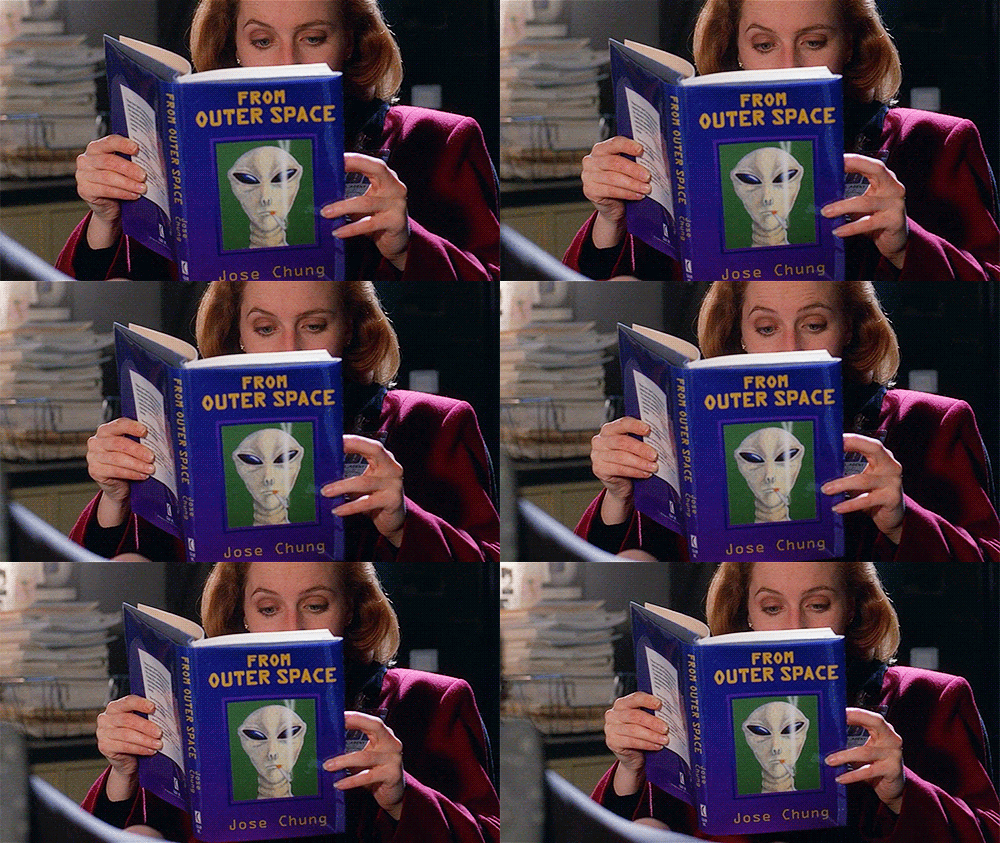
Season 3 Episode 20: Jose Chung From Outer Space
Season 5 Episode 12: Bad Blood
Season 6 Episodes 4 and 5: Dreamland Part 1 and 2
Season 6 Episode 6: How the Ghost Stole Christmas
Season 6 Episode 15 Arcadia
Season 7 Episode 13: X-Cops
I already have a huge craving to rewatch the first seven seasons of this show, and I'm so sad that I have watched them all! I'm cheering myself up by reminding myself I have season X to watch yet, and soon there will also be a season 11. I have lower expectations for the reboot but I still think I will enjoy it. Have you watched the reboot yet? What did you think?
I can officially say this is my all-time favorite T.V. show and I'm so glad I finally made the commitment to watch it. It's so worth the time investment! I will now be forever trying to fill the X-Files sized hole in my T.V. watching soul.
Subscribe to:
Posts (Atom)